Pokemon Card Condition & Grading Explained
In this guide
“Condition” and “grade” are two different things. Condition is an informal description of a raw (un-slabbed) card's wear. A grade is a number assigned by a third-party company after they've inspected and sealed the card. Both affect price, and the words get used loosely, so it's worth being precise.
Raw card condition
Most marketplaces and price guides (including TCGPlayer, which underlies a lot of Pokemon pricing data) use a five-step scale. Sellers assign it themselves, so treat it as a claim to verify against the photos, not a fact.
- Near Mint (NM). Looks essentially unplayed. At most tiny, hard-to-see imperfections — a very slight edge nick or a minor surface flaw under angled light.
- Lightly Played (LP). Minor wear visible on close inspection: light edge whitening, small scratches, a soft corner. Still an attractive card.
- Moderately Played (MP). Obvious wear — noticeable whitening, scratches, light creasing, or minor border wear — but structurally sound and not defaced.
- Heavily Played (HP). Major wear: heavy whitening, creasing, scratching, water damage, or writing. Clearly a well-used card.
- Damaged (DMG). Significant damage — tears, large creases, bends, holes, or heavy water damage.
The gap between NM and LP prices is often large, and between NM and MP larger still, so a listing described as “NM” that shows edge wear in the photos isn't the deal the price suggests. This site reads the condition wording out of a listing's own title and prices the card against that condition rather than always assuming Near Mint — details on the methodology page.
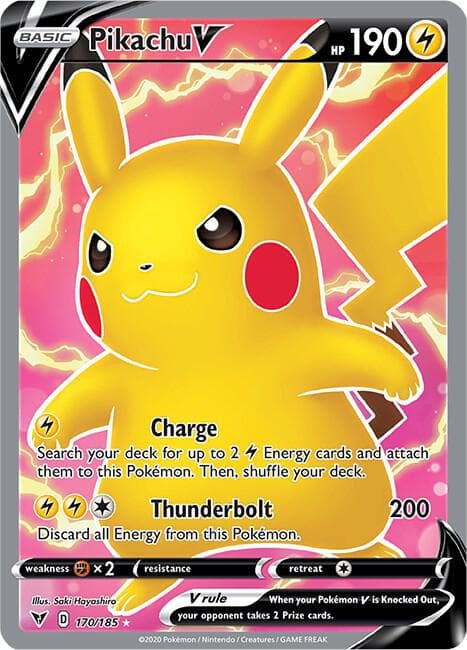 Pikachu V (Full Art) from Vivid Voltage
Full art: edges and surface show wear first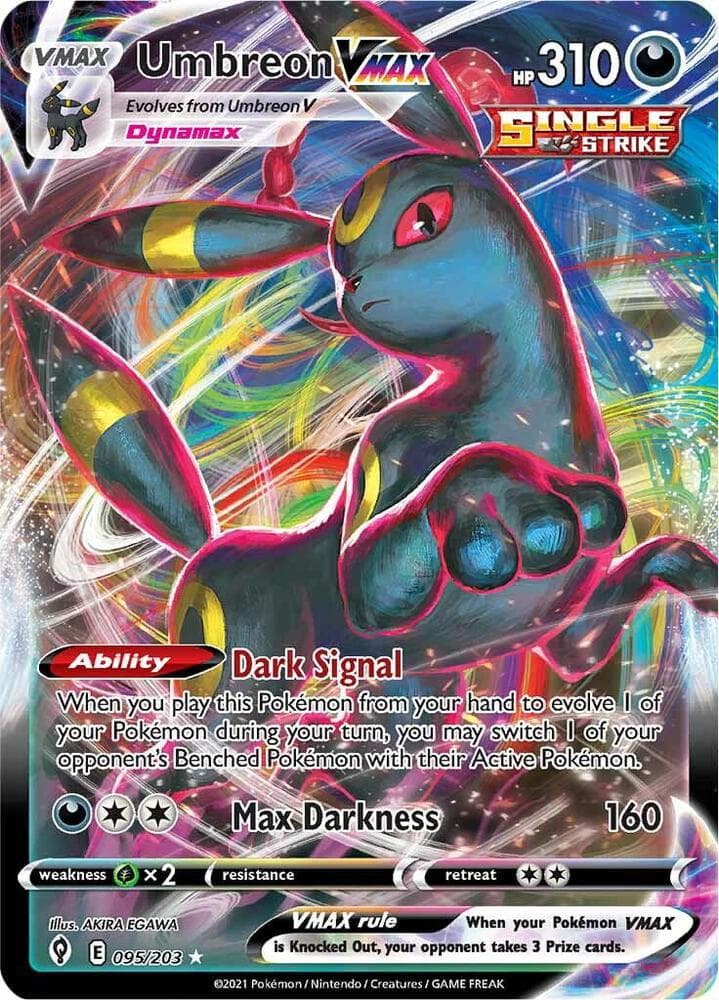 Umbreon VMAX #095/203
Textured VMAX: check the surface under angled light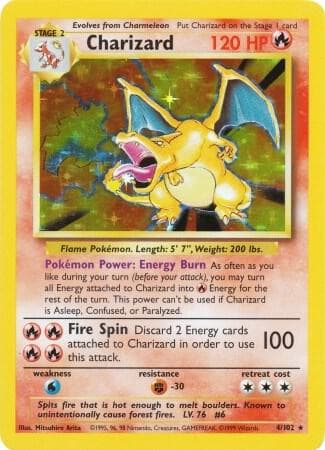 Base Set Charizard
Vintage holo: corners and centering carry the most weight
Third-party grading
Grading companies authenticate a card, assign a numeric grade, and seal it in a tamper-evident holder (a “slab”). The grade is theirs, not the seller's, which is why graded cards trade in their own market. The main companies you'll see in Pokemon listings:
- PSA. The most common for Pokemon by volume. A single 1–10 whole-number scale (with a rarely-used half grade at 1.5). PSA 10 is “Gem Mint”; PSA 9 is “Mint”. No sub-grades on the label.
- CGC. A 1–10 scale in half-point steps, with a distinct “Pristine 10” above the standard “Gem Mint 10”. Sub-grades (centering, corners, edges, surface) are recorded.
- BGS (Beckett). A 1–10 scale in half-point steps with four sub-grades on every label. A BGS 10 is rare; a “Black Label” 10 (all four sub-grades 10) is rarer and priced accordingly. BGS 9.5 (“Gem Mint”) is the common high grade.
- SGC, ACE, TAG. Smaller graders also seen in listings. SGC uses a 1–10 scale; ACE and TAG are newer entrants, TAG using computer-vision grading and a 1–10 scale to one decimal place.
Grades are not interchangeable across companies — a PSA 10 and a CGC 10 don't command the same price, and the market usually pays the most for PSA at the top end for Pokemon. When you compare graded prices, compare like for like: same company, same grade. On this site, graded listings are only ever priced against real sold records for that exact company and grade.
For what the number itself communicates — what a 7, 8, 9 or 10 means, and what usually separates them — see the grading scale, 1 to 10. To judge a raw card before you buy it or send it in, see how to check a card's condition.
Practical takeaways
- Judge a raw card from clear, in-focus photos of all four corners and the full surface.
- “Mint” in a raw listing is a seller's opinion; a graded “10” is a company's.
- A cheap graded card at a mid grade (say a PSA 6) is a legitimately cheaper card, not a bargain on a PSA 10.
- Compare a listing only with the same printing: the set and card number tell look-alikes apart — Base Set Charizard is #004/102, the Base Set 2 reprint is #004/130. The price checker searches by card number as well as name.
- Browse graded deals specifically on the graded filter.
Common questions
What do Pokemon card condition grades mean?
“Condition” is an informal description of a raw (un-slabbed) card’s wear, assigned by the seller on a five-step scale from Near Mint to Damaged. A “grade” is different: a number assigned by a third-party company after it inspects and seals the card. Both affect price.
What is Near Mint (NM) condition?
A card that looks essentially unplayed, with at most tiny, hard-to-see imperfections — a very slight edge nick or a minor surface flaw visible only under angled light.
What is Lightly Played (LP) condition?
Minor wear that is visible on close inspection: light edge whitening, small scratches, or one soft corner. Still an attractive card.
What is Moderately Played (MP) condition?
Obvious wear — noticeable whitening, scratches, light creasing, or minor border wear — but the card is structurally sound and not defaced.
What is Heavily Played (HP) condition?
Major wear: heavy whitening, creasing, scratching, water damage, or writing on the card. Clearly a well-used card.
What is Damaged (DMG) condition?
Significant damage such as tears, large creases, bends, holes, or heavy water damage.
What is the difference between raw and graded Pokemon cards?
A raw card is un-slabbed; its condition is the seller’s own claim, so verify it against the photos. A graded card has been authenticated, assigned a numeric grade, and sealed in a tamper-evident holder by a company such as PSA or CGC — the grade is theirs, not the seller’s, so graded cards trade in their own market.
What do PSA, CGC and BGS grades mean?
PSA uses a 1–10 whole-number scale (PSA 10 is “Gem Mint”, PSA 9 is “Mint”) with no sub-grades on the label. CGC uses 1–10 in half-point steps with a distinct “Pristine 10” above the standard “Gem Mint 10” and records four sub-grades. BGS (Beckett) uses 1–10 in half-point steps with four sub-grades on every label; BGS 9.5 is the common high grade and an all-10 “Black Label” is the rarest.
Keep reading
- The Pokemon card grading scale, 1 to 10 — what each grade number means and what separates a 7, 8, 9 and 10.
- How to check a Pokemon card's condition — the hands-on inspection: centering, corners, edges, surface, and what to photograph.
- Raw vs. graded Pokemon cards — why the same card costs several times more in a slab, and when grading is worth it.
- How Pokemon card prices are determined — how condition, grade, edition and printing split one card into many prices.
- Look up any card's raw and graded value: browse by Pokemon, or check current graded deals.