The Pokemon Card Grading Scale, 1 to 10
In this guide
A card's grade is a number from 1 to 10 that a third-party company assigns after it inspects the card and seals it in a holder. People also call it a “rating”. It is separate from the informal Near Mint–to–Damaged condition scale a seller uses for a raw card — that is the seller's own claim; a grade is the company's.
What each grade means
The names below (Gem Mint, Mint, and so on) are common hobby vocabulary. The exact tolerances — how many microns of edge wear, what centering ratio — are each grading company's own and are not published in full. Treat this as “roughly what the number communicates”, not a checklist that produces a guaranteed result.
| Grade | Common name | Roughly what it communicates |
|---|---|---|
| 10 | Gem Mint | Looks flawless to the naked eye. Sharp corners, clean edges, an unmarked surface, and centering that is close to perfect on both sides. |
| 9 | Mint | One very minor flaw on close inspection — a tiny edge speck, a hint of a soft corner, or slightly off centering. |
| 8 | Near Mint / Mint | A couple of small flaws: light edge wear, a slightly rounded corner, minor centering that is noticeable but not severe. |
| 7 | Near Mint | Light wear that is easy to see up close — minor whitening on edges or corners, a small surface scratch, or clearly off-centre. |
| 6 | Excellent / Near Mint | Moderate wear: visible corner and edge whitening, light scratching, or a small print/surface defect. |
| 5 | Excellent | Obvious handling wear — rounded corners, edge whitening around much of the card, scratches, but no creases. |
| 4 | Very Good / Excellent | Heavier wear, possibly a very light surface crease or bend, along with the corner/edge wear above. |
| 3 | Very Good | A well-handled card: creasing, heavy whitening, scuffing, maybe a light stain. |
| 2 | Good | Major wear — multiple creases, heavy scuffing or scratching, corner damage. |
| 1 | Poor | Severe damage: large creases, tears, missing material, heavy staining or writing. |
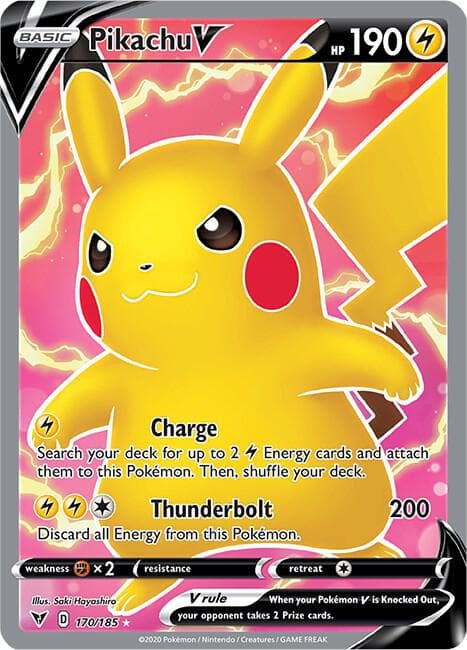 Pikachu V (Full Art) from Vivid Voltage
Full art - surface and edges decide the top grades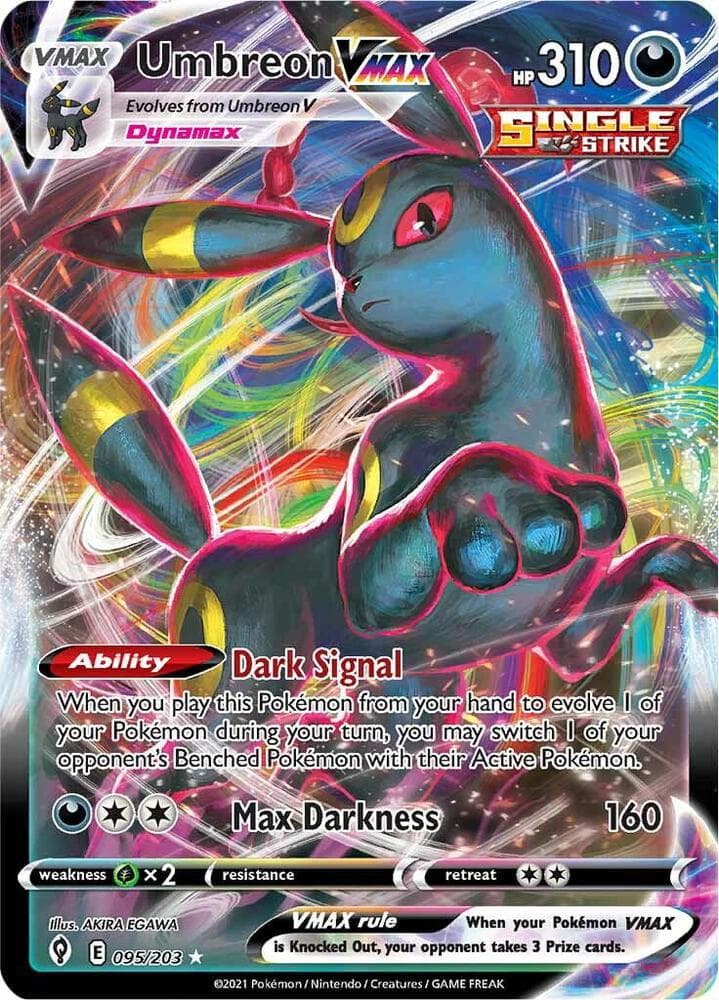 Umbreon VMAX #095/203
Textured VMAX - centering is the usual separator
What usually separates a 7, 8, 9 and 10
It is rarely one thing. Graders weigh four areas together, and the grade tends to track the worst of them: a card with three perfect areas and one soft corner is judged on the soft corner. Moving from a 7 to a 10 usually means each of these areas gets cleaner, not that one problem is fixed.
| What to look at | How | What usually costs points |
|---|---|---|
| Centering | How even the border is on the front (and back). Measured as a ratio, e.g. 60/40 means one border is 1.5x the opposite one. | Borders that are visibly uneven left-to-right or top-to-bottom. Back centering also counts, usually less strictly. |
| Corners | All four corners under angled light and slight magnification. A sharp corner comes to a clean point. | Fraying, whitening, softness or a visible bend at the tip — even on one corner. |
| Edges | The full perimeter, front and back, for the pale line that appears where the top layer chips. | Whitening, nicks, roughness or a factory mis-cut along any edge. |
| Surface | The card face tilted against a light: print quality, holo pattern, scratches, indentations, print lines and any residue. | Scratches, scuffs, print dots or lines, dents, a light bend, cloudiness on holo, or a fingerprint that won't wipe. |
| Creases & bends | Flex the card gently (or view it edge-on against light) — a crease breaks the fibres and usually shows as a line. | Any crease is a hard ceiling on the grade, even a faint one visible only under light. A bend with no fibre break is less severe but still counts. |
Centering is the one people most often misjudge on their own cards. A card that looks “fine” in hand can be 65/35 once you measure the borders, and that alone can be the difference between a 9 and a 10.
Why the scales are not identical across companies
- PSA uses whole numbers 1–10 (with a rarely-used 1.5). No sub-grades on the label.
- CGC uses 1–10 in half-point steps, records four sub-grades, and has a distinct “Pristine 10” above the standard “Gem Mint 10”.
- BGS (Beckett) uses 1–10 in half-point steps with four sub-grades on every label; an all-10 “Black Label” is the rarest outcome and BGS 9.5 is the common high grade.
- SGC, ACE, TAG also use 1–10; TAG grades by computer vision to one decimal place.
Because the criteria and the label differ, the same card can come back a 9 at one company and an 8 or a 10 at another, and the market pays different amounts for each — usually the most for PSA at the top end for Pokemon. When you compare graded prices, compare the same company and the same number — a card page here lists each company's grades as separate rows once there are enough recent sales, as on Umbreon VMAX #215/203 from Evolving Skies. A fuller company-by-company overview is on the condition & grading guide.
The grading company makes the final call
Nothing you can see at home guarantees a number. Graders use magnification, controlled lighting and measurement, weigh the four areas differently from each other, and can disagree — which is why the same card is sometimes re-submitted for a higher grade. If you want to form a realistic expectation before you pay for grading, work through how to check a card's condition first.
Common questions
What is a grade 10 Pokemon card?
A card a grading company judged to look flawless to the naked eye — sharp corners, clean edges, an unmarked surface, and near-perfect centering. It is often labelled “Gem Mint”. It is not a guarantee of perfection under magnification.
What is a grade 9 Pokemon card?
“Mint” — one small flaw on close inspection, such as a faint edge speck, a slightly soft corner, or centering that is a little off. Still a high grade that trades well.
What is a grade 8 Pokemon card?
Usually “Near Mint–Mint”: a couple of minor issues — light edge wear, a slightly rounded corner, or noticeable centering — but no creasing.
What is a grade 7 Pokemon card?
“Near Mint”: light wear that is easy to see up close — minor whitening on edges or corners, a small surface scratch, or a card that is clearly off-centre.
Is a card's grade the same as its condition?
No. “Condition” is the informal Near-Mint-to-Damaged scale a seller assigns to a raw card. A “grade” is a number a third-party company assigns after it inspects and seals the card. People say “rating” for either one.
Do PSA, CGC and BGS use the same grading scale?
All three run 1–10, but not identically. PSA uses whole numbers with no sub-grades on the label. CGC and BGS use half-point steps and record four sub-grades (centering, corners, edges, surface); CGC has a “Pristine 10” above its standard 10, and BGS has an all-10 “Black Label”. So a “9” is not automatically the same card at each company, and prices differ by company even at the same number.
Keep reading
- Pokemon card condition & grading explained — the raw condition scale and every grading company in one place.
- How to check a Pokemon card's condition — the hands-on inspection before you buy or submit.
- Raw vs. graded Pokemon cards — when a grade is worth paying for, and when it is not.
- Compare grades in the market: browse current graded deals, or look up any card's raw and graded value by Pokemon or in the price checker.