Holo or Reverse Holo? Check the Listing's Printing
Published 22 September 2026 · Last checked against the official sources 22 September 2026
In this guide
A listing that says “Umbreon 059/131” has not told you which card is for sale. The foil treatment is part of the card's identity, so one collector number can cover a plain printing, a reverse holo and one or more pattern printings — separate cards, separate prices. This guide is how to make a listing tell you which one it is, before you pay.
The short version
- Look the number up first and see how many cards it covers. If it covers three, the listing has three possible answers and you need one of them.
- Ask the seller to name the printing in words — plain, reverse, or a named pattern. An answer you can read beats an image you have to interpret.
- Do not take “holo” in a title as the answer. It is written loosely to mean “shiny”, including by honest sellers.
- Ask for an angled photograph under a single light if you want to judge it yourself. A flat, straight-on scan cannot show how a foil behaves.
- If it is graded, the printing should appear in the grader's record as a variety — check it against the label.
Reverse foils are not an exotic variant, which is why this comes up so often: a Pokemon booster pack contains ten game cards, of which three are foils with at least one rare or higher, and sets before Scarlet & Violet guarantee at least one reverse foil card per pack. (source: Pokemon Support: booster pack contents)
Why the collector number will not settle it
Because the printing is part of the card's identity, not a finish applied to one card afterwards. Our catalogue holds separate records for separate printings, and they carry separate prices. The clearest live example on this site is in Prismatic Evolutions, where three distinct records share the number 059/131:
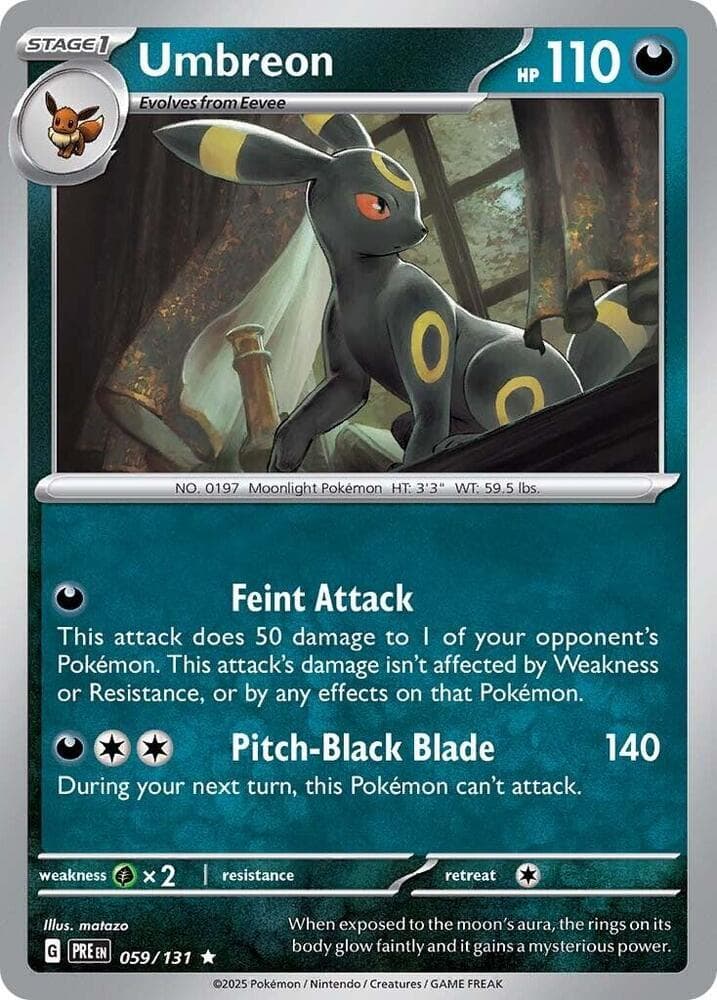 Umbreon 059/131
Base printing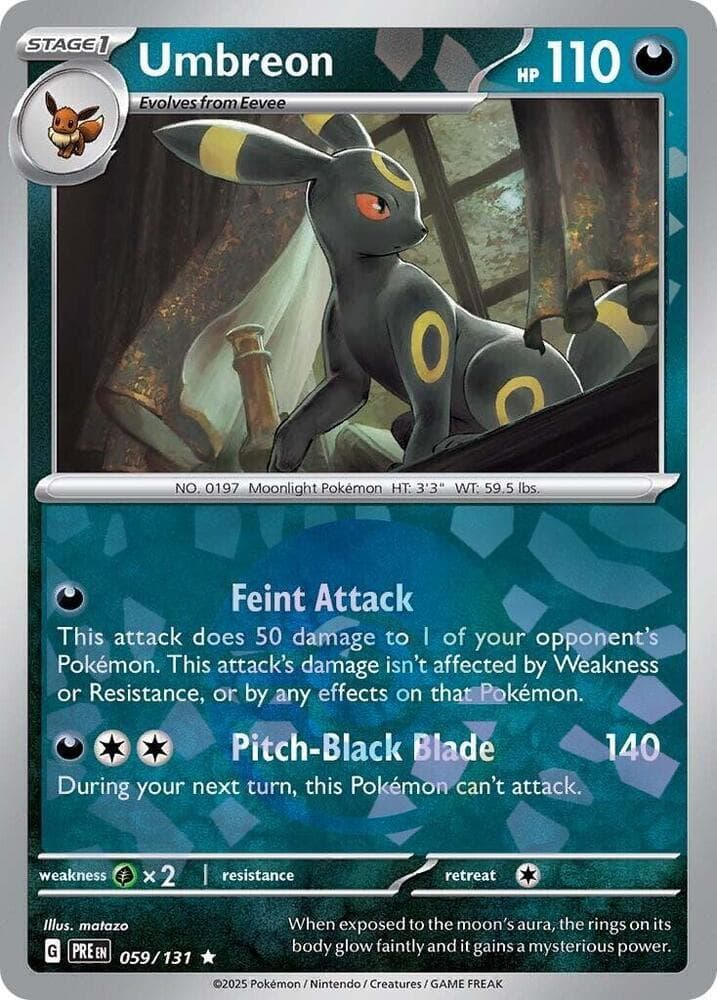 Umbreon 059/131 (Poke Ball Pattern)
Poke Ball Pattern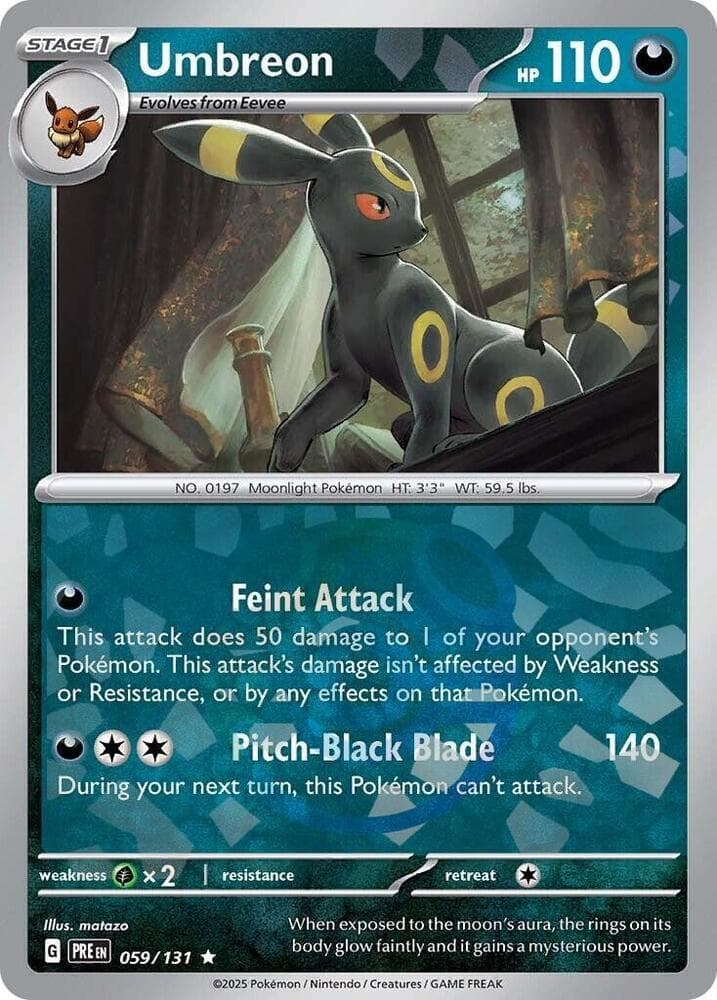 Umbreon 059/131 (Master Ball Pattern)
Master Ball Pattern
Modern sets carry treatments beyond plain reverse foil — the Poke Ball and Master Ball patterns above, and set-specific ones like the Quick Ball pattern on Pawniard 146/217 in Ascended Heroes, whose printing our catalogue records as part of the card's name. The structural point is the same in each case: if the printing has its own record, it has its own market.
What the pictures on this page can show you
They show which record each card is, which is the point being made. They cannot show how a foil moves under a light: these are flat catalogue scans, and no flat image demonstrates a finish. Use them to see that three separate cards exist under one number — not to judge which finish you are looking at.
Why this matters for price
Because a comparison is only meaningful between the same printing. If a reverse holo is priced against a reference for the plain card, the saving is not real — it is a comparison between two different products. We gate that deliberately: a listing whose printing we cannot evidence shows no savings claim rather than a flattering one. The reasoning is in how prices work and in our methodology.
Where to go next
- Look up a card by number — separate records appear separately, so you can see the printings a number covers.
- The Prismatic Evolutions guide — the worked example above, in full.
- Reading a listing — the rest of what a listing does and does not tell you.
Sources
- Pokemon Support: what to expect in a booster pack
- Read 22 September 2026. Collector numbers, printings and record counts are our own catalogue records, read the same day.
- Our card images are flat catalogue scans, so this guide identifies a printing from the listing rather than from how a foil looks.