Spotting Fake Pokemon Cards in a Listing
Published 17 September 2026 · Last checked against the official sources 17 September 2026
In this guide
You are looking at a listing, something feels off, and you want to know whether to buy it. This page is about that decision. It is not a list of ten tells that prove a card is fake — most such rules have real exceptions, and a photograph cannot settle authenticity in either direction. What a listing can do is give you enough to walk away, or enough to ask better questions before your money moves.
What the official guidance actually says
The Pokemon Company's own support article on counterfeits is short, and worth reading before any third-party checklist. Its suggestions are about a card in your hands, not a photo: holding a card up to a bright light, because many counterfeits are easier to see through that way; knowing what official packaging looks like, so a knock-off box does not get the benefit of the doubt; and price — a pack priced dramatically below suggested retail is treated as a near-certain sign of counterfeit merchandise. It also suggests asking a shop that specialises in trading cards to look at anything you are unsure about. (source: Pokemon Support)
Notice what is missing: no font chart, no border measurement, no universal texture rule. That restraint is deliberate, and this guide follows it. Print runs, regional printings and finishes vary legitimately, and a rule that holds for one era can be wrong for the next.
Why a photograph cannot settle it
Three of the most commonly cited tells are exactly the ones a listing photo handles worst.
- Colour. White balance, phone processing and lighting shift card colour far more than a print-run difference does. Any colour comparison worth acting on happens physically, with both cards under the same light — not across two photographs taken in different rooms.
- Shine. Holo pattern and gloss depend almost entirely on the angle of the light. A flat, dull-looking holo usually means the photo was taken straight on.
- Price. A low price is a reason to look harder, and the official guidance treats a far-below-retail sealed pack as a serious warning. But a cheap single is not proof of anything: condition, a motivated seller and a thin market all produce genuine bargains.
The same applies in reverse. A crisp, well-lit, convincing photo is not proof a card is real — it may not even be a photo of the card you will receive. A single image, whatever it shows, is not an authentication.
Real cards that look wrong
A large share of “is this fake?” questions are about genuine cards whose appearance is unfamiliar. Before treating an oddity as a red flag, check whether it has an ordinary explanation.
| What looks wrong | The ordinary explanation | Where it is explained |
|---|---|---|
| Same card, different printing run | Base Set Charizard exists as 1st Edition, Shadowless and Unlimited. They differ in the art-frame shadow, the copyright line and more - all genuine. | Base Set printings |
| A promo number that looks malformed | Promos do not use 25/102 numbering. BW90, SWSH042, SVP 053 and a plain black-star 8 are all correct for their eras. | Promo numbers explained |
| A modern card of a classic | 30th Celebration's Classic Collection reprints older cards in a current frame. A 2026 Charizard that looks nothing like a 1999 one is not evidence of a fake. | Reprint or original? |
| Foil where you did not expect it | In 30th Celebration every card is foil, including Basic Energy. A shiny Basic Energy from that set is exactly what it should be. | 30th Celebration guide |
| A rarity you have never seen | 30th Celebration introduced Futuristic Rare, headlined by Mew ex and Mewtwo ex. New rarities appear regularly. | Mew and Mewtwo |
The 30th Celebration facts above — every card foil including Basic Energy, and the new Futuristic Rare rarity — come from the official announcement and expansion page (announcement, expansion page).
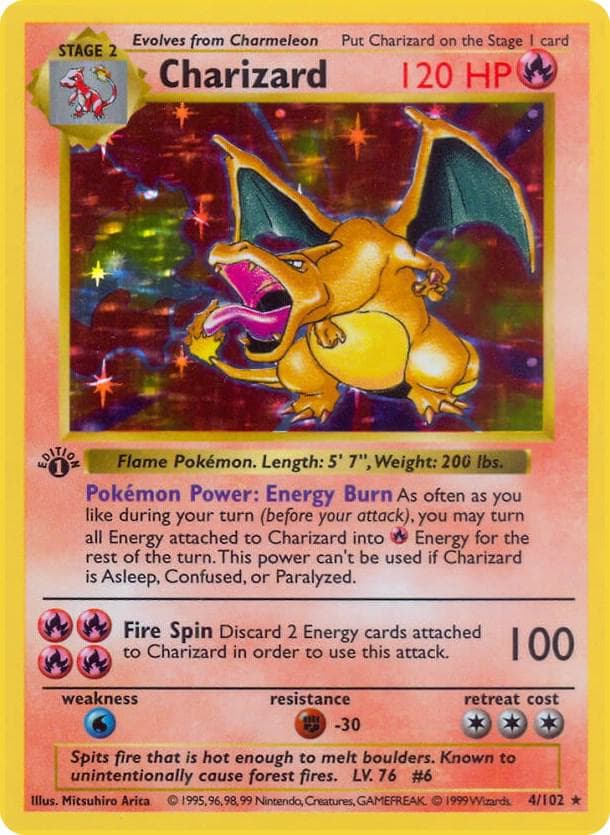 Shadowless Charizard
Shadowless printing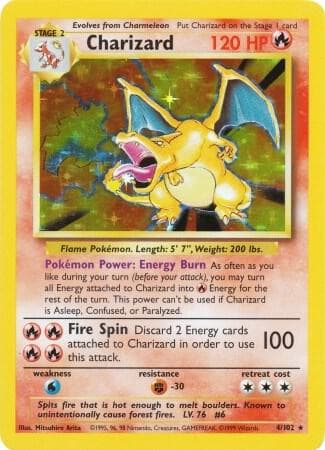 Base Set Charizard
Unlimited printing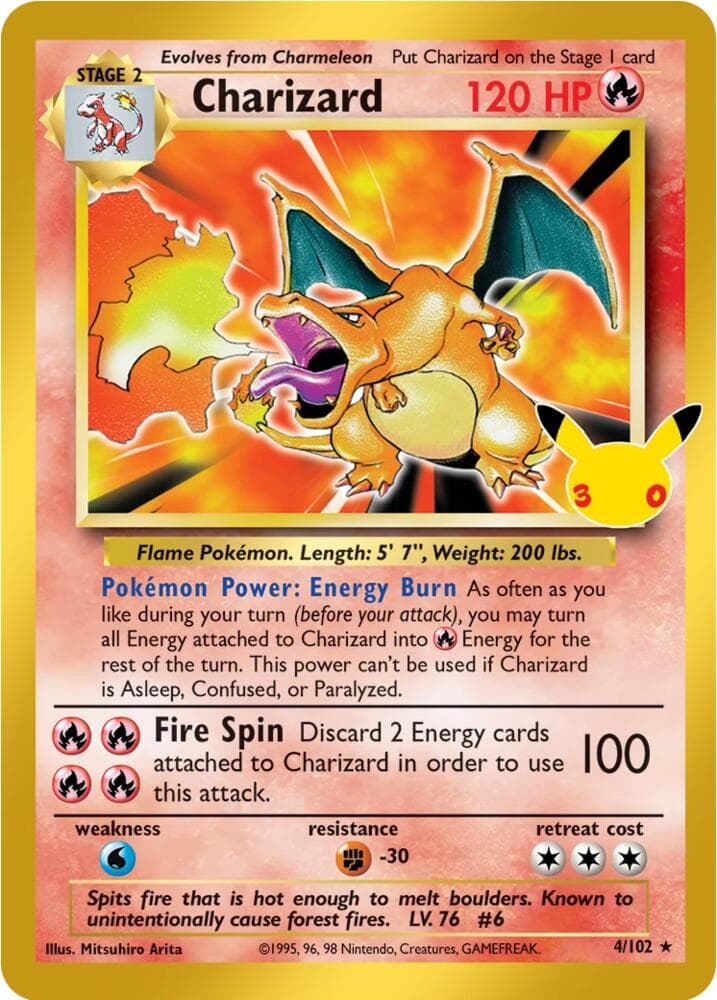 Charizard 4/102 (Classic Collection)
2026 Classic Collection reprint
What to ask a seller for
The practical move on a listing you are unsure about is not to squint harder at the photo you have. It is to ask for photos that are hard to fake and easy to read.
- The actual card, not a stock image. Ask for a photo of the card next to something identifying — a handwritten note with their username and the date is the usual request.
- The back, flat and straight on. It is the part most often cropped out of a listing photo, and having it in good light lets you look properly once the card arrives.
- Both edges, at an angle. Useful for spotting a card that has been trimmed, which matters for grading value even when the card is genuine.
- The holo at two different angles. One angle tells you little; two tell you whether the pattern moves as it should.
- For a graded card, the label and certification number. Then verify that number on the grader's own site and check it describes the same card.
A seller who will not photograph the card they are selling has answered the question for you. Refusal is the signal — not any single feature of the image.
When to pay someone else to decide
Past a certain value, stop reasoning from photographs. The Pokemon Company's own suggestion is to take a questionable card to a shop that specialises in trading cards. (source: Pokemon Support) For a purchase you have not made yet, eBay's Authenticity Guarantee does this inside the transaction: on eligible trading-card listings the card ships to PSA first, and for an ungraded card their experts run a multi-point inspection and check the listing details before it continues to you. For a graded card they authenticate the case and label rather than regrading it, and the programme accepts slabs from PSA, SGC, CGC Cards and BGS. It applies above a published value threshold rather than to every listing (buyer page, programme details).
That threshold and the coverage differ by marketplace and change over time, so read the current figure on eBay's own page and check for the badge on the listing itself rather than assuming. Below it, on a card expensive enough to hurt, buying one already graded by a recognised grader moves the authenticity question to someone who examined the physical card. Our raw vs graded guide covers what that costs you and when it is worth it.
What this site screens, and what it does not
Every listing shown here passes an automated screen before it is displayed. It is worth being precise about what that does.
- Listing wording. Titles that advertise a proxy, a custom or a reproduction are rejected outright, so a card that openly describes itself as not genuine never reaches a deal page.
- Listing photos. An out-of-band visual screen compares a listing's image against the catalogue artwork for the card it was matched to. A counterfeit verdict hides the listing; a wrong-printing verdict also hides it, as a matching error rather than an accusation.
- Identity. A listing must still match the catalogue card it was matched to, and the link must open that exact listing, or it is not shown.
The limitations matter more than the checks. This screening reads a listing — its words and its photographs — and nobody here handles the card. It cannot detect a counterfeit that is photographed well, or one listed with an honest-looking title. Listings that have not been screened carry no verdict at all, and absence of a verdict is not a pass. Nothing on this site is an authenticity guarantee, and a listing appearing here is not a statement that the physical card is genuine. Treat it as a filter that removes some bad listings, not as a substitute for the checks above.
A short working order
- Check whether the odd thing has an ordinary explanation — printing, promo numbering, reprint, finish.
- Compare the listing against the card's own page for the expected printing and a recent-sold reference: start from the price checker.
- Ask for the specific photos above. Judge the response, not just the images.
- Above a value you would mind losing, buy graded or buy through an authentication programme.
- If you have already bought and you believe it is counterfeit, open a dispute with the marketplace first.
Reference prices on this site are recent-sold guides, not valuations, and they say nothing about whether a particular card is genuine. A price that looks too good is a prompt to ask questions, and that is all it is.